

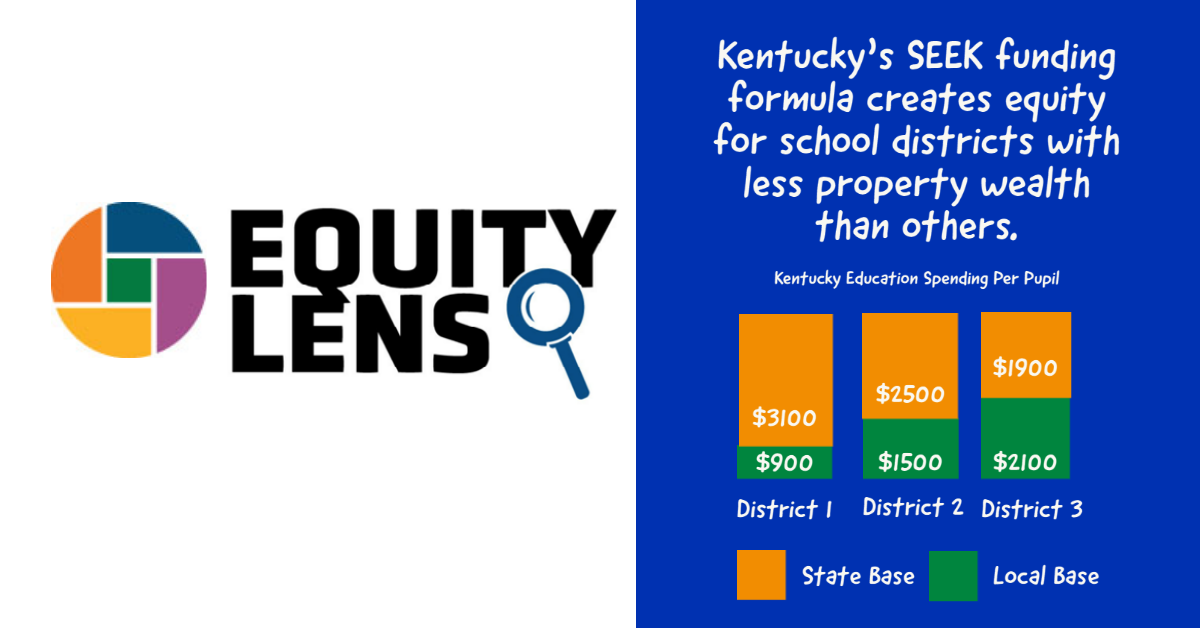
Imagine two districts that both set a tax rate of 30¢ per $100 of taxable property. The amount that produces will depend on how much property they have to tax. If one district has $300,000 in taxable property per pupil, it will bring in $900 per pupil in revenue. If the other has $700,000, it will bring in $2,100.[/vc_column_text][vc_empty_space][vc_column_text animation=”slideInLeft”]SEEK levels that out. After districts raise the 30¢ revenue, the state adds what each one needs to get to a base guarantee amount. The current guarantee is $4,000 per pupil. That means the district that brings in $900 will receive $3,100 per student, while the district that brings in $2,100 will receive $1,900. What’s important is that students in both districts end up with matching resources at the guaranteed $4,000 level.[/vc_column_text][/vc_column][vc_column width=”1/4″][vc_single_image alignment=”center” onclick=”custom_link” link_target=”_blank” image=”15184″ animation=”slideInRight” link=”https://prichard-backup.com/wp-content/uploads/2021/07/SEEKExplainer.July2021.pdf”][/vc_column][/vc_row][vc_row][vc_column][vc_empty_space][vc_column_text animation=”slideInLeft”]SEEK Adds Equity for Added Student Challenges
Some educational basics are the same for all learners, but there are also variations. For example, there are added costs to serve students with very low family incomes, students who are learning English for the first time, students with medical conditions that require home/hospital services, and students with identified learning disabilities.[/vc_column_text][vc_empty_space][vc_column_text animation=”slideInLeft”]SEEK provides “add-on” dollars to meet those challenges. The amounts are set as percentages of the base guarantee, ranging from 9.6% of the base amount for each English learner to 235% of the base for students with severe disabilities.[/vc_column_text][vc_empty_space][vc_column_text animation=”slideInLeft”]The add-ons reflect the central concept of equity: giving students similar levels of opportunity can require different levels of resources.[/vc_column_text][vc_empty_space][vc_column_text animation=”slideInLeft”]Transportation costs also vary from district to district. In smaller independent districts, buses may only have to travel a couple of miles to pick up many students. In larger rural county systems, the distances may be much larger, and the cost per pupil much higher.[/vc_column_text][vc_empty_space][vc_column_text animation=”slideInLeft”]SEEK also calls for districts to receive add-on dollars based on state calculations of each district’s transportation costs.[/vc_column_text][vc_empty_space][vc_column_text animation=”slideInLeft”]The transportation add-on is designed to apply equity in an additional way: giving students similar opportunity to get to school even when the distances are very different.[/vc_column_text][vc_empty_space][vc_column_text animation=”slideInLeft”]One more thing: the transportation add-on is currently not working right. For many years, the General Assembly has provided amounts too small to meet the needs, and state law has required that the districts with the greatest needs take the greatest funding reductions. This problem deserves its own blog post, which we will publish in the weeks to come.[/vc_column_text][vc_empty_space][vc_column_text animation=”slideInLeft”]SEEK Equalizes Some Additional District Effort
What if districts want to raise revenue above the 30¢ minimum?[/vc_column_text][vc_empty_space][vc_column_text animation=”slideInLeft”]SEEK allows that, and promises some equalization of what they can raise, so that students end up with similar resources when their districts set similar tax rates. This optional of SEEK is called Tier 1.[/vc_column_text][vc_empty_space][vc_column_text animation=”slideInLeft”]Tier 1 is capped at 15% of each district’s SEEK base and add-on revenue. In 2021, all 171 Kentucky school districts claimed Tier 1 revenue up to that maximum level.[/vc_column_text][vc_empty_space][vc_column_text animation=”slideInLeft”]SEEK Allows, but Limits, Further District Efforts without Equalization
What if districts want to go even further, taxing themselves to raise more than the Tier 1 maximum? They’re allowed to do that. Those final dollars are called Tier2 dollars, and they get no equalization.[/vc_column_text][vc_empty_space][vc_column_text animation=”slideInLeft”]Tier 2 also has a cap. Districts are allowed to use local taxes to raise up to 25% more than their total from SEEK base, add-ons, and Tier 1. The Tier 2 cap puts a limit on how far funding differences between districts can grow.[/vc_column_text][vc_empty_space][vc_column_text animation=”slideInLeft”]That means some districts have a much harder time raising money than others. Consider two districts that both want to raise an extra $210 per pupil. That will require a 7¢ additional tax if a district has $300,000 in taxable property per pupil, but only an added 3¢ if it has $700,000 to tax.[/vc_column_text][vc_empty_space][vc_column_text animation=”slideInLeft”]SEEK Has Room for Improvement
While SEEK’s strengths deserve respect, there are certainly ways to make the formula stronger.[/vc_column_text][vc_empty_space][vc_column_text animation=”slideInLeft”]
-
- The base guarantee could be set based on education cost and adjusted as those costs change. Current funding rises and falls with state budgets and with little regard to changes in the cost of living.
- The add-ons could reflect an evidence-based look at students’ added needs and the realistic costs to give every student a shot at full adult success and participation.
- Tier 1 could be reconsidered. If every district is taking every available penny, is it really optional? And if it isn’t optional, would it make more sense to distribute those dollars based on a larger base guarantee and a larger standard local effort?
- State funding shortfalls could be handled more fairly. At present, if the General Assembly underfunds part of the formula or the Governor orders midyear reductions, the districts that need the most state resources take the biggest losses. That doesn’t have to continue.


Comments are closed.