


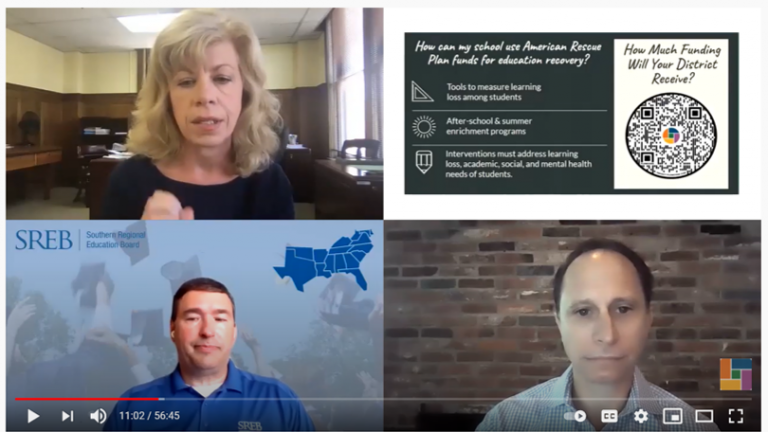
[/vc_column_text][vc_empty_space height=”10px”][vc_video media_url=”https://www.facebook.com/prichardcommittee/videos/3561274047251121″ css=”.vc_custom_1599239959138{padding-top: 0px !important;}”][vc_empty_space][vc_column_text animation=”slideInLeft”]Panelists explored the theme of re-imagining public education during the Prichard Committee’s latest episode of “Innovations in Education” this week. Panelists included:“As we move into the 6th month of the pandemic and a new school year, innovations are being made to help ALL kids in each school and district,” said Prichard Committee President and CEO Brigitte Blom Ramsey, “but we must lift up those examples of innovations to create a truly equitable system when we emerge from this difficult time in our nation’s history.”
- Denise Forte, the senior vice president for Partnership and Engagement at The Education Trust.
- Robin Lake, director of the Center on Reinventing Public Education (CRPE), a non-partisan research and policy analysis organization developing transformative, evidence-based solutions for K–12 public education.
- John P. Bailey, visiting fellow at the American Enterprise Institute (AEI), works on finding new ways to reskill individuals who have lost their jobs during times of economic disruption, whether because of normal business cycles, automation, or artificial intelligence.
- Alex Spurrier, senior analyst with Bellwether Education Partners in the Policy and Evaluation practice area. Prior to joining Bellwether in March 2019, Alex worked as a senior data scientist at the Kentucky Center for Statistics.
[/vc_column_text][vc_empty_space height=”10px”][vc_column_text animation=”slideInLeft”]Key Takeaways“So many educators and students are rising to the occasion,” said Lake. “There’s a lot of latent problem-solving potential that we hadn’t tapped yet. We have to identify these innovations, adopt them, and move them.”
- Forte said that a new report from The Education Trust shows that engagement in districts to students and families has increased rapidly in the pandemic. “It’s so critical that students know that they are still cared for in light of the pandemic. Any opportunity to engage students is so important,” she said, adding that the flipside is many districts are also reporting that they’ve lost from 10-20% of students and weren’t able to reconnect over the summer.
- Spurrier and Bailey discussed the emergence of “micropods” – parents in local communities working together to provide home-learning and support for their kids throughout times of virtual learning. Spurrier pointed out that pods can be seen as inequitable, as parents from lower-income families cannot pay tutors or take time off work to help tutor their own children. He’s published an article about how pods can be more equitable. Bailey said, “Pods didn’t exist 5 weeks ago, and it’s too soon to say what the impact will be. They mean different things for different people.”
- Lake addressed the challenge of student assessments, but said that results for will be critical in gauging where students stand academically. “Now is a really important time to think about how assessments evolve. Teachers and parents know that data matters. We need to use this moment to reinvent assessments so they are meaningful and powerful.”






Comments are closed.