

As we work toward Kentucky’s Big Bold Future, the Prichard Committee is considering implications for key groups within our commonwealth. Today, it is time to focus specifically on Latino Kentucky. The future we seek will require Latino talents and contributions and building that future will require sustained attention to Latino concerns and Latino success.
Here’s a first image to show us three big things about los estudiantes latinos de Kentucky.

First and foremost, Kentucky’s Latino enrollment and Latino graduates have both grown rapidly. This group of students will be a powerful part of our shared future, and we must be sure to develop their full talents and strengths. We are becoming an increasingly Latino commonwealth.
Second, enrollment is well ahead of graduations, alerting us to work ahead to deliver full success for Latino students.
Third, Latino participation is smaller at KCTCS than in K-12 education, and smaller still at public universities, signaling that we also have work to do on access and inclusion in higher education.
To build full inclusion and full flourishing for these learners, what work will we need to do? Our very first thought is that Latino voices –from students, families, educators, and community members– must be part of figuring out those answers.
With that clarity about the importance of collaboration in mind, we’ll share some K-12 data that may indicate some zones where we need to build.
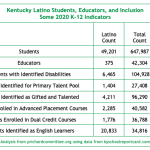
These numbers highlight important reasons for serious attention to:
- The strength of recruitment and retention efforts for Latino educators, where we are nowhere close to numbers proportionate to enrollment
- The accuracy and equity of identification of disabilities and inclusion in talent pools, gifted and talented programs, and advanced coursework, where Latino students are underrepresented
- The effectiveness of English learner programs where Latino students are a majority of those being served
There are sure to be other zones where shared work should begin, and for higher education, the key areas for attention may be similar or different.
We also know that cultural responsiveness always matters, both in the substance of what is being taught and in systematic approaches to access, welcome, respect, and empowerment. For example, the recently completed National Hispanic Heritage Month reminds us that many of us have a great deal to learn about Hispanic culture, experience, and history. Understanding and attention on those issues can feed into more relevant curriculum, more responsive engagement with students and families, and deeper collaboration among Kentuckians of many different backgrounds.
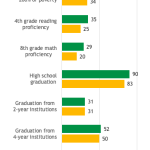
Kentucky is in the lower half of all states on most of the national indictors we are tracking in our Big Bold Future initiative, and Latino outcomes are often a step below that. The chart below shows most of those indicators. Household median income is our last indicator, and there we also know that Latino household income of $42,317 lags well behind Kentucky overall at $50,247. Building a stronger Kentucky will require special attention to delivering for Latino Kentucky.
The Prichard Committee is using these indicators to summon Kentucky to the work of nuestro Gran Futuro Audaz. We are glad that that future will include vibrant contributions from Kentucky’s growing Latino community, and we are committed to educational work that respects and builds on the talents and cultural strengths of Latino Kentuckians.