

The Bowling Green and Warren County community came out in force the next day. Volunteers helped clear debris, and donations streamed into community organizations. After two-plus years of COVID-induced isolation, the community came together to heal. It was a heart-warming tale broadcast across the country by network news crews starved for some silver lining during the holiday season.
This gracious response to the tornadoes continues our community’s pattern of helping those in need. Bowling Green has long welcomed refugees with the help of the International Center of Kentucky. At my school, Greenwood High, children of Bosnian, Burmese, Vietnamese, Somali, and now Afghan refugees provide a welcome and increasing diversity to our mostly white student body. Our school and district provide English Language Learner classes to help ease the transition to our school and country. In 2016, our district opened GEO International High School, touted as “the first and only 4-year high school for international and refugee students of its kind in Kentucky.”
Between destructive tornadoes, a deadly virus, and worldwide violence that delivers refugees to our doorstep, our school and larger community have responded time and again with compassion to help fulfill its mission of student safety, achievement, and opportunity. But one area where our collective response has not met the urgent need is to improve the quality of education for our Black students, who have consistently displayed an achievement gap when comparing our district’s first and most recent Equity Scorecards (2015-16 and 2021-22, respectively). What needs to be done to make a real change in a district where 95 percent of the teachers are white and approximately 10 percent of our students are Black?
In the wake of the protests following the murders of Breonna Taylor and George Floyd in 2020, I sought to answer that question for myself. As an English teacher, I turned to books and started the Greenwood Antiracism Book Club (ABC), inviting the whole faculty to join. Each month, we read and discussed ways to better educate ourselves about the history of racism in the United States and ways to make our school more equitable for all. Attempting to put some of what we learned into action, we quickly realized that reading and talking were not enough, so we analyzed school and district policy for inequities. This antiracism work helped lead me to a fellowship with the Prichard Committee, where I began to take this effort district-wide, hoping to create a team of teachers dedicated to learning about equity and acting on that knowledge to make a change.
Although the effort to expand district-wide is ongoing, it is hard to review this school year’s work as anything more than a failure. After reaching out to many educators across our district, we had a promising first meeting to discuss Carla Shalaby’s Troublemakers. The group was small–six or seven–but I was encouraged to meet some new faces at other schools and had assurances from others about “next time.” When we met that next time, I felt like the kid who gets stood up at prom. I had read my book (Gholdy Muhammad’s Cultivating Genius), taken notes, and prepared discussion questions and talking points. One person, a parent and former Site-Based Decision-Making committee member showed up and sheepishly admitted she hadn’t read the book. Another member, also a parent and SBDM committee member, joined via Google Meet from her car. She also hadn’t read the book.
Although we had a nice discussion, I kept thinking about what had gone wrong: were people too busy to participate?; were people too fatigued by COVID?; did no one care?; were people scared of the anti-Critical Race Theory crowd in a politically conservative area?; should I have offered this for professional development credit?
All of these are possible and probable, and as a person always able to find the negative in any situation, I could probably build a much longer list. However, I will attempt to flip it and find the positive. As a teacher of writing, I talk constantly to students about how the process is more important than the product, so here is my chance to follow my own advice. My project may be on life support, but during the process, I made the following progress:
- I met with the Prichard Committee’s Chaka Cummings to get more information about the organization’s Equity ToolKit, an excellent resource to use for future equity initiatives.
- From my conversation with Cummings, I shared a piece of the toolkit with my district’s Director of Intervention, whom I met with to talk about offering our book study as professional development. From this conversation, I learned that while everyone in our district’s leadership is concerned about equity, it is not one person’s job description or title.
- I provided recommendations to a member of our district’s Equity Council for the Equity Scorecard, including one to create a director of equity initiatives. I also advocated for improving our identification of exceptional students of color for Gifted and Talented services after speaking with our district’s GT director at a professional development session.
- I strengthened relationships with a Western Kentucky University professor, Dr. Dye, who is involved with several programs seeking to elevate Black youth, and Marie-Louise Mallah-Mbanfu, a leader in local efforts to assist refugee resettlement.
- I recommended our principal hire Dr. Dye to provide professional development on equity (or cultural proficiency as our district calls it). She had led this before, just as the anti-CRT movement was heating up.
- I connected with Michael Coleman, who is in charge of our district’s minority recruitment efforts, regarding the Young Male Leadership Academy. This group provides opportunities to get more students of color interested in education careers. I tried to recruit a couple of students to join this district group when I saw none were involved this year.
None of these actions alone will create a monumental impact that will close achievement gaps for our district’s students of color, but with an antiracism group working together across the district, continuous improvement can be made.
The latest Equity Scorecard results paint a dire picture of the achievement gaps for Black students in our district. In 2020-21, 17.5 percent of Black students earned proficient or distinguished on the state assessment for elementary reading. This was the second-lowest subgroup, with only English Learners coming in lower, at 12 percent. Scores were down almost 50 percent for Black students from the original Equity Scorecard (35% proficient/distinguished in 2014-15).
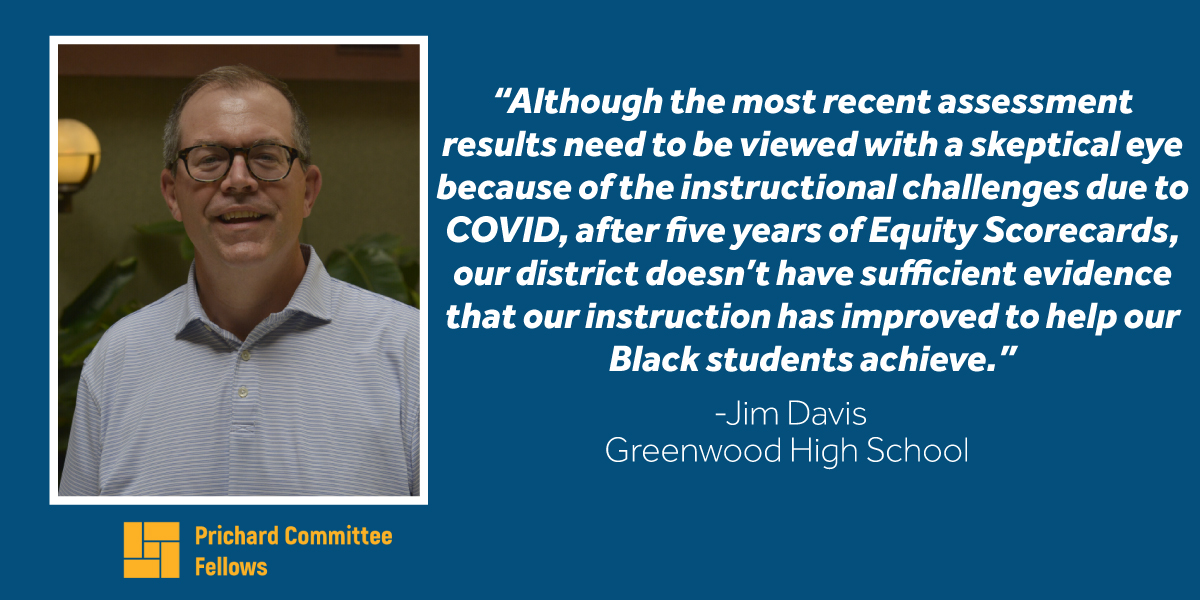
Although the most recent assessment results need to be viewed with a skeptical eye because of the instructional challenges due to COVID, after five years of Equity Scorecards, our district doesn’t have sufficient evidence that our instruction has improved to help our Black students achieve. When faced with this educational disaster, a situation reflected in schools across the country, we have a choice to make: throw our hands up and say the kids can’t learn or recognize there are systemic problems that need to change.
If we brought the same energy to educating our Black students that we use to recover from a natural disaster, survive a pandemic, or provide refugees safe haven, then we could fix this problem, too. My project taught me that this fix won’t come from one person or program but from the collective, continuous effort that will lead to change.[/vc_column_text][/vc_column][/vc_row]

Comments are closed.