

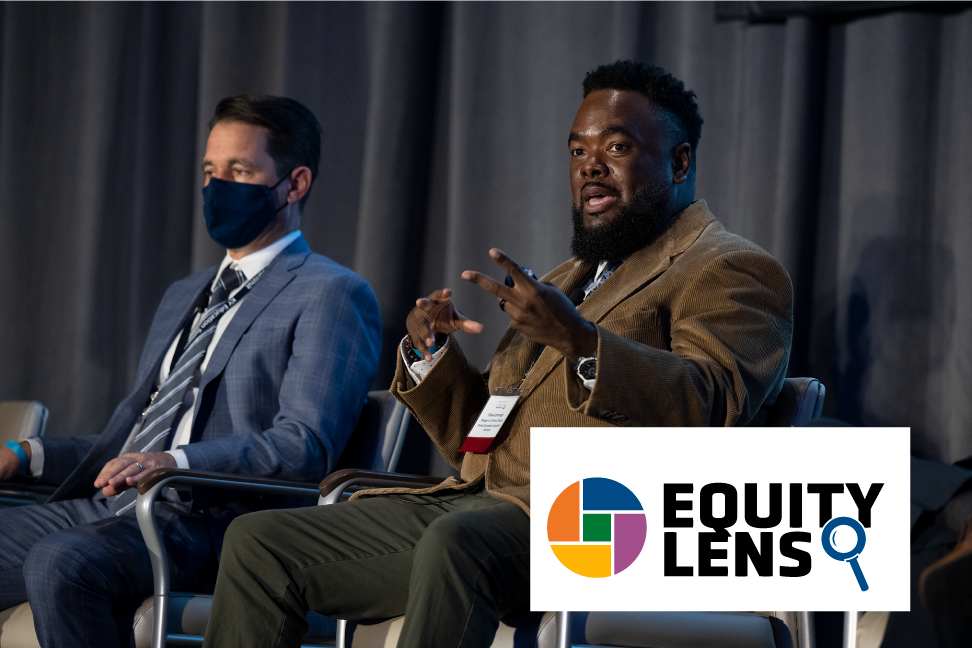
One major perspective shared was around teacher shortage, specifically around a shortage of diverse teacher populations in Kentucky. Teaching Matters Most cites research around improved education outcomes in terms of graduation rates, college going, and student discipline when students of color have teachers of color. Research from the Learning Policy Institute also points out that white students have improved outcomes when encountering teacher of color, as well. Linda Darling-Hammond, who both works with the Learning Policy Institute and was a keynote at the Summit, referenced this. The questions remain: how do we increase the number of students of color in teacher preparation programs in Kentucky and how do we increase diversity within the teacher pipeline? One consideration is looking at the impact administrators of color have on retention and recruiting teachers of color.[/vc_column_text][vc_empty_space][vc_column_text animation=”slideInLeft”]Access to Dual Credit and Advanced Placement Courses
As Prichard has reported in earlier blog posts, there have been gains made in the number of opportunities for historically marginalized groups with regards to advanced placement courses and dual credit courses. The advantages for these students are numerous and critically important to students regarding college readiness and successful transition. There is still ample opportunity across the Bluegrass to improve and close gaps for historically marginalized students in this area. As Tony Wagner stated in the Summit, schools must center play, purpose, and passion. Access to advanced coursework is a tool that helps students and school in this endeavor.[/vc_column_text][vc_empty_space][vc_column_text animation=”slideInLeft”]Centering Student Voice
The inclusion of diverse perspectives on the Commissioner’s Student Advisory Council is a powerful example of why student voice must be a part of the conversation on improving education outcomes. Student spoke to the need for centering equity for students across the Commonwealth in the future of Kentucky public education. This included considering the spaces in which we student voice is invited, whether that be in schools, on committees and boards, and legislatively. Our collaboration with the Kentucky Student Voice Team on the Coping with COVID student surveys is a reflection of this important work.[/vc_column_text][vc_empty_space][vc_column_text animation=”slideInLeft”]Teachers Have a Lot on their Plate
The role of teachers in schools has evolved, especially as the philosophies and legislation guiding educational responsibilities have changed, through KERA, No Child Left Behind and Common Core Standards. Combining the evolution of the profession with a national teacher shortage with the impacts of COVID, and you have a perfect storm that has made being a classroom teacher more difficult than it has ever been. Lu Young, Chair of the Kentucky Board of Education, spoke to the legislation pre-filed for the 2022 Kentucky General Assembly on teaching about race and Kentucky history, saying it adds another complicating factor that does not support the needs of students or advancing equity. The Prichard Committee wholly supports this perspective.[/vc_column_text][vc_empty_space][vc_column_text animation=”slideInLeft”]Evolution of State Assessment
Achievement gaps in student performance on assessments only continue to increase; and COVID only exacerbated these gaps. As the future of education evolves, assessment is a significant part of that consideration. How should education assessment adjust to ensure measurement of essential skills? What should be considered regarding the frequency of summative assessments? These are important questions to consider, as well as centering equity and closing gaps for historically marginalized student achievement. Excellence with equity in education means, paraphrasing Professor Pedro Noguera’s wisdom from the summit, finding ways to use assessment as a tool versus as a weapon.[/vc_column_text][vc_empty_space][vc_column_text animation=”slideInLeft”]Thanks to the Kentucky Department of Education for offering the Summit at such a critical time. There are so many opportunities for innovation in Kentucky education, and stakeholders like teachers, students, administrators, advocates, and legislators voiced their commitment to moving Kentucky toward a more equitable educational future.[/vc_column_text][vc_empty_space][vc_column_text]Photo Credit: Marvin Young, Kentucky Department of Education[/vc_column_text][/vc_column][/vc_row]

Comments are closed.